Discover Textile 2026
Textile 2026, launching alongside FESPA Global Print Expo in Barcelona (19–22 May 2026), is where function, print, and production converge to shape the future of textiles.
Choosing between inkjet and screen printing depends on your business goals. Screen printing excels in high-volume, cost-effective production with diverse textures. Digital inkjet (DtG/DtF) suits short-run personalization and inventory management. Success lies in matching technology to your target market—premium, sportswear, or promo—while considering material compatibility and productivity.
Garment printing continues to offer a good business opportunity for anyone looking to diversify, or to expand their business, or even to start up a new business. The scale of this opportunity will only increase as the population continues to grow. And there are several ways to meet this demand, which also makes it easier for new players to differentiate themselves.
The most obvious type of garment to start with is the ubiquitous t-shirt, which is popular with all age groups regardless of gender. There’s a ready supply of blank t-shirts and two basic options for decorating or customising those t-shirts: the conventional choice of screen printing; or the digital route through inkjet. Naturally there are pros and cons to both.
The first question to consider should always be how much you want to sell the final product for, closely followed by how much profit you want to realise from the business. That will set the tone for the whole enterprise and determine the maximum manufacturing cost that you can afford. Do you, for example, want to target the premium market with a high quality product or are you planning to use personalisation to justify higher pricing or are you aiming to maximise volumes with lower prices? The answers to these questions will determine the best route into this market.
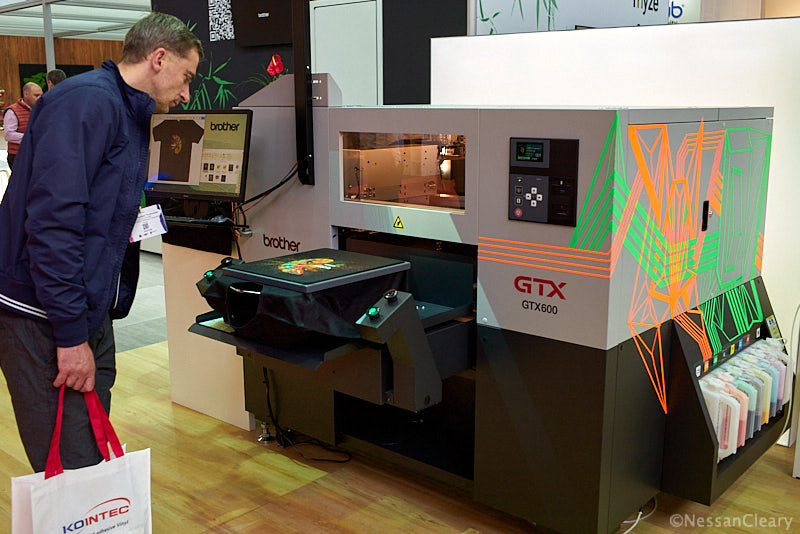
Regardless, the level of profit will largely depend on managing the manufacturing cost. Productivity will play a major part in this, as higher volumes generally lead to lower costs per individual unit. The main difference between the conventional and digital approaches is the volume that can be produced by a single operator. Screen printing can potentially be the most efficient, assuming a highly automated screen printing machine with a large number of stations. Such set-ups can easily realise 900 items or more in an hour. Most digital Direct-to-Garment printers can’t come anywhere close to this. However, many vendors such as Kornit and Aeoon have introduced DtG printers with multiple stations to increase their productivity. Kornit’s Apollo is the highest volume digital printer but with a relatively high cost of investment.
However, where digital technology scores is the ability to produce very short runs, even down to one, with every t-shirt being unique. Naturally such personalisation can command a premium price. In recent years we’ve seen Direct-to-Film take a bigger slice of this market, as it can satisfy the personalisation at a lower unit cost. Some will argue that a DtG print to a cotton t-shirt produces a better feel, but it’s hard to argue against lower costs, especially as many personalised garments are intended for relatively short term use, such as hen parties and trade shows.
And there is more to short run production than just personalisation. It can also be used for more efficient management of inventory, with stock only printed when needed to avoid the costs of warehousing and reduce the risk of having unsold stock left over that has to be destroyed or sold off cheaply.
Another factor to consider is the ability to add special effects and multiple colours. Most digital printers only offer a standard CMYK configuration; even white ink may be standard or an option. Kornit has gone a little further offering various effects such as raised textures. But ultimately most digital printers are limited by the number of printhead channels, with extra channels significantly increasing the cost. It’s relatively straightforward to add extra screen print stations and these can be used to print a wide range of different effects from neon colours to textured features.
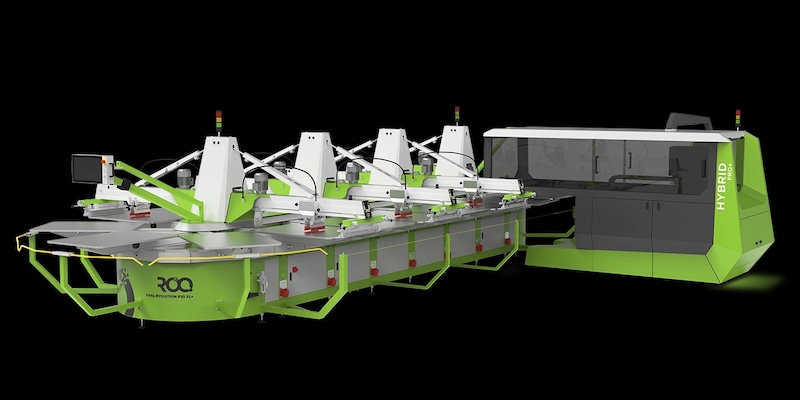
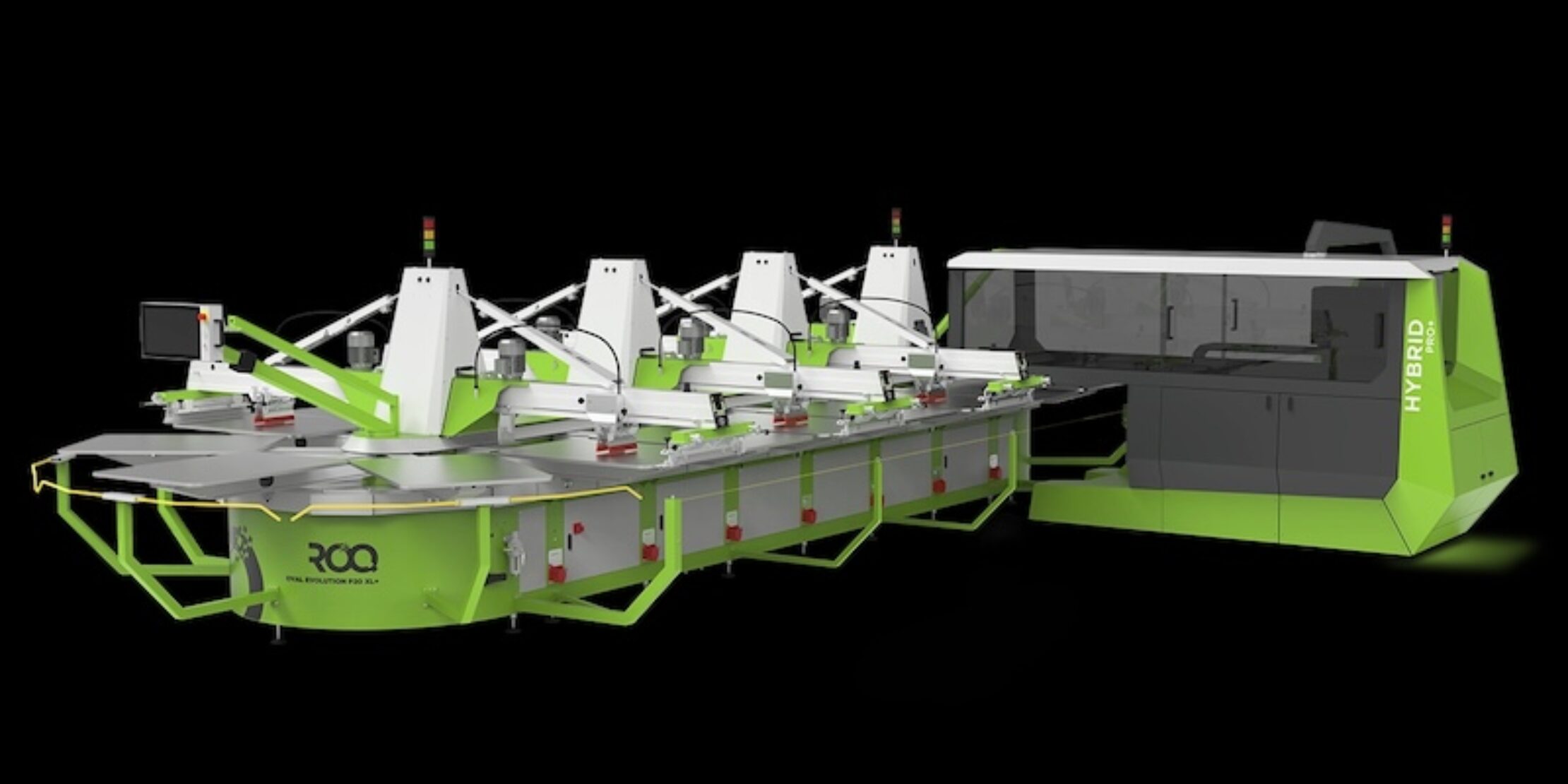
A hybrid press that combines digital with screen printing can offer the advantage of personalisation with special effects with relatively high levels of productivity. Roq, for example, has just announced a new press, the Hybrid Pro+ that combines a digital print unit with a standard automatic screen print machine. This set up can produce around 550 items per hour, with just a single operator.
Screen printing also scores in terms of material flexibility as it can be used across a wide range of different fabrics. The premium end of the t-shirt market is dominated by cotton, or a cotton-heavy blend, which has a more luxurious feel, while the sportswear market mainly uses polyester, which is lighter. The various digital technologies tend to target one material or the other. Dye sublimation is limited to polyester while most DtG printers will only print to cotton, though there are some DtG printers that are designed to print just to polyester. DtF is generally more forgiving in terms of fabrics.
Another factor to consider is the hand feel, which is harder to quantify and largely comes down to personal preference. The fabric itself has a large part to play in this as well as the way the ink interacts with the fabric. With dye sublimation, for example, the ink is sublimated into the fibres without affecting the texture of the fabric. However, dye sublimation requires a two-step process, printing first to a transfer paper and then sublimating the print in a heat press. In contrast, DtG printers use pigment inks that sit on top of the fabric and require a pretreatment to bind with the material. However, improvements to the chemistry mean that most DtG printers produce a very thin film that allows the natural texture of the fabric to be felt through the ink to produce a reasonably natural feel. With screen printing there is a greater choice of inks though some do use a high level of plastisol that can lead to a rather plasticky feel.
In conclusion, there are a number of factors to consider meaning that the choice between different technologies isn’t so straightforward. The most important issue to determine is how you want to differentiate your products in the market. And that ultimately comes down to choosing the market sector you want to operate in – such as premium or sportswear – and the technology that comes closest to this. But in most cases, the issue is not so much a choice between technologies, but how to blend the different methods together to produce the most fully rounded way to address the overall market.
Textile 2026, launching alongside FESPA Global Print Expo in Barcelona (19–22 May 2026), is where function, print, and production converge to shape the future of textiles.