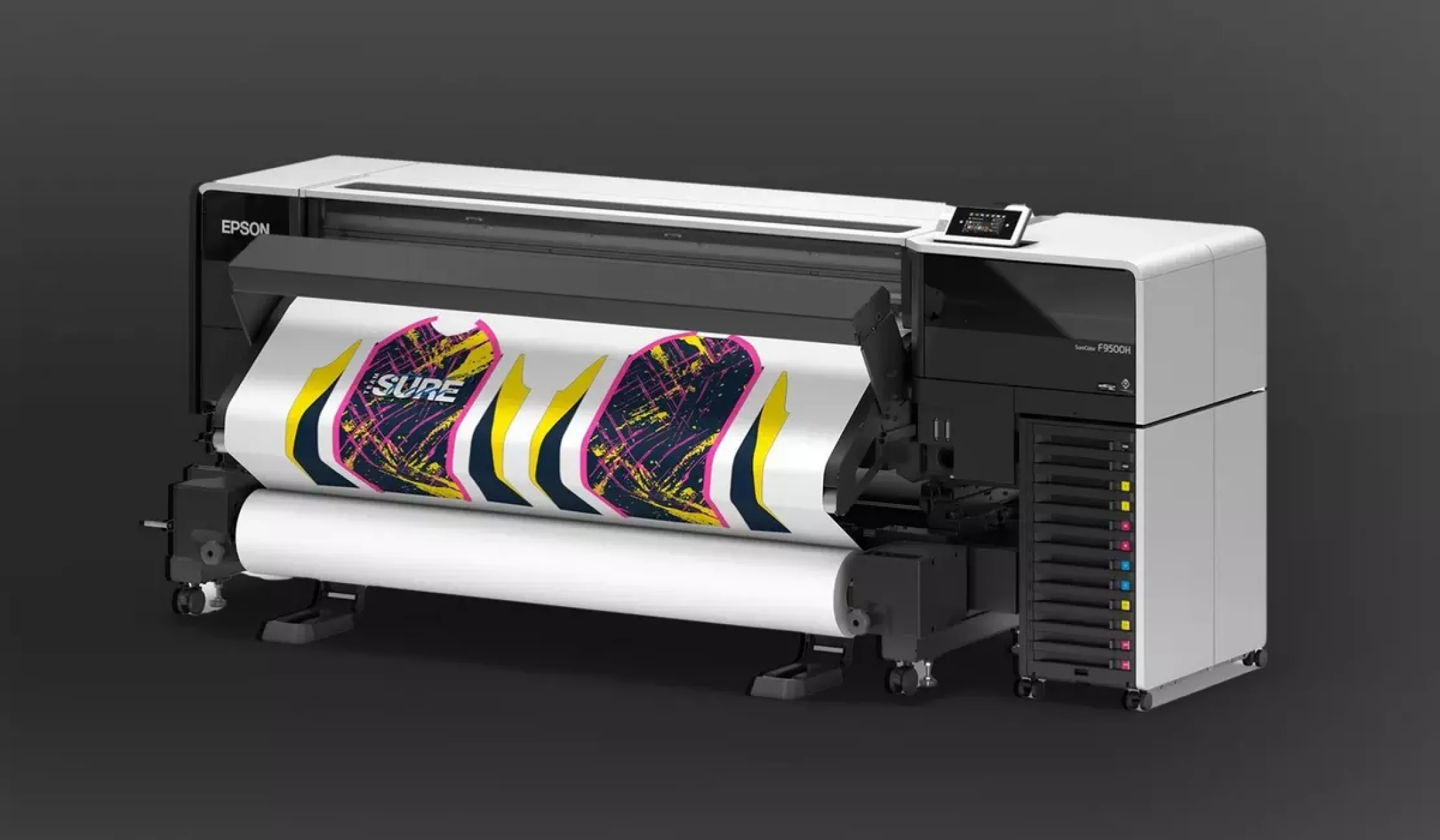
Colour management in dye sublimation
Become a FESPA Member
to Continue Reading
What are the technical foundations of dye sublimation printing on textiles and how has colour management in the sector evolved? Club FESPA Online spoke to Paul Restarick of Epson.
“Our conversation is very timely,” Paul Restarick, Pre Sales Technical at Epson UK, says, “because in recent years Epson has invested a lot of time and money in profiling and colour management.”
He points to Epson’s Precision Dot technology as central to that development. Recalling “traditional profiling”, Paul outlines the complexity that once defined the process.
“Traditional profiling usually involves minimisation in limit per channel, transition from light to dark inks, total ink limit. So, you’re managing lots of areas.”
Operators had to determine how much ink each channel could accept, when lighter inks such as light cyan should give way to darker variants, and how to control total ink laydown. If linearisation – “effectively achieving a good curve with your CMYK ink set” was not correct, the final ICC profile would inevitably be compromised.
Profiling the substratePrecision Dot, he explains, simplifies this foundation. “Precision Dot is three core technologies – what droplet and what pass do you lay that down in to reduce visible banding, a halftone module, and our lookup tables.”
All Epson printheads can produce three different droplet sizes. The system determines what droplet size do we use, where and when. In addition, Epson engineers in Japan have developed substrate-specific lookup tables.
“For sublimation, for example, we have a lookup table for thin, thick and adhesive. With these different lookup tables, it gives everyone a starting point straight away. That removes the requirement for linearisation, or managing the change from, say, a light cyan ink to a dark cyan ink. It’s mangaged in the lookup table.”
This is particularly significant in dye sublimation, where the printed transfer does not represent the final visual result. Paul stresses that profiling must be carried out on the finished substrate.
“When you’re profiling dye sublimation, you profile the final substrate. It could be polyester fabric. It could be polyester-coated ceramic for mugs or tiles. The white point there is obviously very important.”
He introduces what Epson calls the IDF value – the Ink Density Factor – which represents the physical amount of ink the transfer paper can hold.
“The IDF value is basically the amount of ink the paper can hold. That’s a constant. So, if the paper hasn’t changed, the…
...