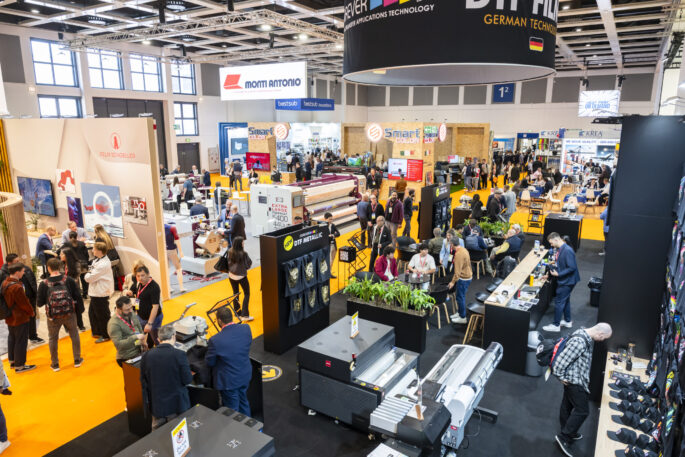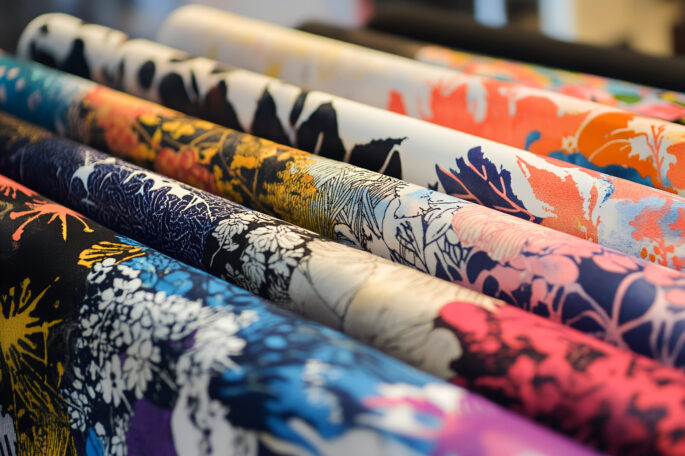
The £8.8 billion digital textile printing market is exploding, driving a sustainable, on-demand manufacturing shift. Key innovations include precise colour management (Barbieri), all-in-one print-and-fix systems (EFI), accessible technology (Epson), automated sewing (FastSewn), and smart software (Fiery). These advances address waste and bottlenecks, enabling high-speed, personalised, and eco-friendly production. Businesses must invest now to capitalise on this commercial opportunity and avoid being left behind.
Is your print business equipped for the future? The digital textile printing market is not just growing; it’s exploding. Forecasted to reach an astonishing $8.8 billion by 2027 (Allied Market Research), this seismic shift presents a monumental commercial opportunity. For businesses poised to embrace innovation, the rewards will be immense. For those that hesitate, the risk of being left behind is very real. The future of textile production is digital, on-demand, and sustainable, and the technologies driving this change are already here.
The challenge for any print business operating in the textile ecosystem is to navigate this rapidly evolving landscape. Success is no longer just about print quality; it’s about agility, efficiency, sustainability, and the ability to offer personalised products at scale. The traditional, water-intensive, and wasteful methods of the past are being displaced by a powerful digital ecosystem.
Let’s explore the key innovations that are not just addressing industry challenges but are actively building the foundations of a smarter, more profitable future for textile printing.
Precision Colour Management: The Foundation of Quality
Waste is the enemy of profit. In printing, nothing creates more waste than inaccurate colour. Getting colour wrong at the start leads to costly reprints, wasted materials, and, most importantly, dissatisfied customers. In a digital workflow, precision is paramount.
Barbieri electronic is tackling this head-on. As Victor Lazzeri from Barbieri explains, there’s a high demand for accurate colour measurement across the diverse materials used in textiles. Their spectrophotometers, like the Spectro LFP qb Textile Edition, are essential tools. “Starting with the right equipment for measurement is the most important thing,” Victor states, emphasising that without it, “you are losing a lot of money… you have a lot of waste and unhappy customers.” By investing in precise colour management, print shops gain full control over their colour output, optimising workflows, saving on ink and media, and ensuring the consistency that is non-negotiable in today’s market.
All-in-One Systems: The Rise of In-Line Fixation
The traditional multi-step process of printing, steaming, and washing is a major bottleneck. It’s energy-intensive, water-hungry, and requires a significant operational footprint.
This is where all-in-one printing systems are revolutionising the industry. EFI Reggiani’s latest EcoNEXT PLUS printers, for example, offer in-line polymerisation. Paolo Torricella from EFI explains that this technology allows for printing and fixation in a single step, drastically reducing the physical footprint, energy consumption, and overall printing costs. Their eco-friendly, solution is suitable for Pigment, Reactive, Acid and direct Dye sublimation (no paper required). As Paolo notes, this integrated approach provides the reliability and consistency needed to “achieve the same results regardless of user dependency,” a critical factor for businesses scaling their operations across multiple facilities.
Accessible Technology: Democratising Creativity and Production
High-volume production technology has often been out of reach for smaller creators, entrepreneurs, and start-ups. This has limited the scope for niche products and on-demand merchandise.
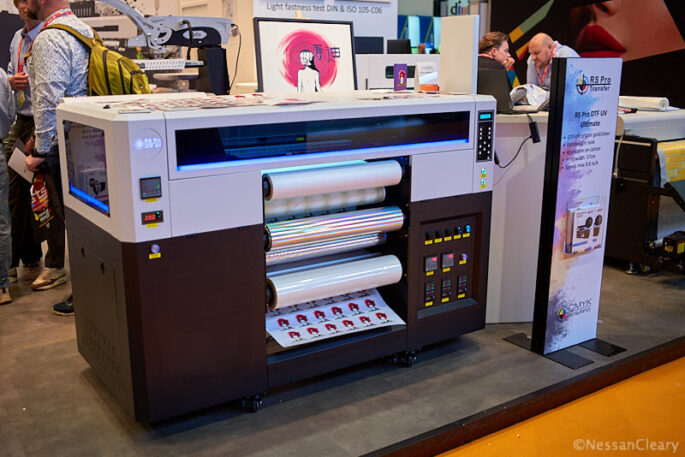
Epson’s “Make On” campaign is a game-changer, designed to democratise the tools of creation. As Tim Check explains, this ecosystem brings together desktop dye-sublimation, UV print, and direct-to-garment systems in an accessible, non-intimidating package. “It’s taking your idea from your mind’s eye to a physical product,” says Tim. By simplifying the user experience and providing a complete ecosystem of software, hardware, and support, Epson is empowering a new generation of entrepreneurs to produce unique, high-quality merchandise with ease, fuelling the explosive growth of on-demand e-commerce.
Automated Sewing: Conquering the Final Frontier
For decades, sewing has remained stubbornly manual. The flexible, unpredictable nature of fabric has made it notoriously difficult to automate, creating a major bottleneck in on-demand production.
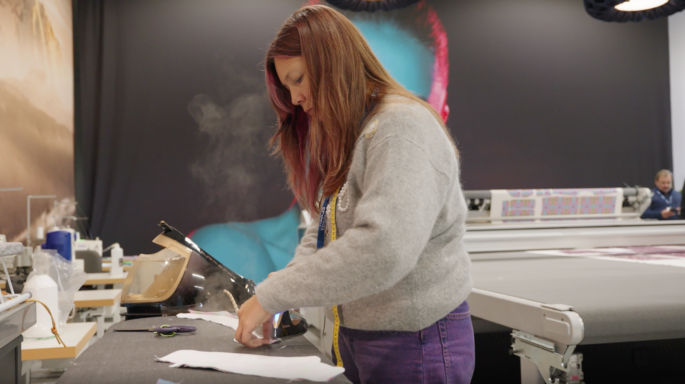
FastSewn, however, has cracked the code. Steen Mikkelsen, the innovator behind the technology, identified that “80% of the time that is spent on the sewing machine is actually handling.” His award-winning solution uses a vacuum to hold the fabric securely on a flatbed, allowing a sewing mechanism to move around it with precision. This automates not just straight seams but also complex contours and shapes. This breakthrough doesn’t just improve efficiency; Steen believes it will create more jobs by elevating the role of the operator from repetitive labour to skilled oversight. This innovation is a critical missing link, enabling true end-to-end automated, on-demand manufacturing for everything from cushions to industrial textiles.
Intelligent Software: The Brains of the Operation
Hardware is only as good as the software that drives it. In the fast-paced world of Direct-to-Film (DTF), DTG, R2R, and e-commerce, colour accuracy, workflow automation, and efficiency are paramount.
Fiery’s new Digital Factory Version 12 is designed to meet these demands. Oriol Martinez from Fiery notes the software simplifies colour management for users who aren’t colour experts, while providing advanced controls for those who are. Critically, it intelligently manages ink levels, particularly white ink. As Oriol explains, better management of white ink leads to a “better hand feel” on the garment and significantly reduces ink consumption and cost. In a market where quality and consistency are key differentiators, intelligent software provides the automated workflow needed to eliminate reprints and maximise profitability.
High-Speed, High-Quality Wide Format: Pushing the Boundaries
The demand for decorated surfaces is expanding from apparel to interiors, including wallpaper, faux leather, and other decorative materials. This requires printing technology that is both fast and capable of producing high-quality results on a wide variety of substrates.
The new HP Latex FS70 W printer addresses this need directly. As Oscar Vidal from HP explains, this 3.2-meter-wide machine is the fastest HP Latex ever made, capable of printing at speeds up to 127 square meters per hour. The use of six inks plus a high-quality white allows for vibrant, detailed printing on diverse media. This technology unlocks the potential for mass personalisation in the decoration market. As Oscar puts it, the combination of quality, speed, and substrate versatility creates a “very bright future for decoration and digital print.”
Sustainable Innovation: The Case of Digital Denim
The denim industry is notoriously one of the most polluting in fashion, primarily due to its immense water and chemical usage. Digital pigment printing offers a radical, sustainable alternative.
Innovations recently discussed by MS Printing Solutions and JK Group demonstrate the power of digital pigment printing to transform this sector. Their process prints directly onto fabric using a water-based pigment ink that requires no pre-treatment or post-washing. This results in a water reduction of over 90% and eliminates dye contamination. The inks are GOTS-certified, meeting the highest sustainability standards. This technology not only offers enormous environmental benefits but also supports faster time-to-market and enhances traceability in the supply chain.
The Power of Automation and AI in Fulfillment
As e-commerce booms, the “Amazon effect” has created an expectation of immediate fulfillment. For garment decorators and print businesses, managing thousands of single-piece orders is a logistical nightmare without sophisticated automation.
ShirtHub, a company that produces 7,000 to 10,000 pieces daily, has navigated this by embracing technology. Dinesh Wahi from Shirt Hub stresses the importance of software and AI, stating, “If you want to be a modern decorator, you have to constantly invest in print technology and software.” Early adoption of digital printing technology from Kornit Digital and the development of custom software has allowed them to streamline operations and keep pace with ecommerce driven by social media trends. This forward-thinking approach shows that investment in digital workflows and AI is no longer optional; it’s essential for survival and growth in the high-volume, on-demand market.
On-Demand Dimensional Decoration: Adding Premium Value
In a crowded market, standing out is key. Dimensional decoration offers a premium, tactile finish that commands higher prices, but traditional methods involve high setup costs and minimum order quantities.
Stahls’ new liquid ink technology, developed with Stratasys, removes these barriers. It allows for on-demand, premium dimensional decorating with no minimums. As Dave Connor explains, the system enables real-time adjustments to dimensions, textures, and colours. “This technology empowers decorators and distributors to say ‘yes’ to any order, whilst adding value and enhanced quantity.” By integrating this capability into e-commerce websites via an API, businesses can offer customers real-time, high-value customisation, opening up new revenue streams and meeting the growing demand for personalised products.
Embrace the Transformation or Be Left Behind
The message is clear: the textile industry is undergoing a profound digital transformation. The innovations driving this change are not futuristic concepts; they are available now, offering tangible solutions to long-standing industry challenges. From colour accuracy and automated workflows to sustainable practices and on-demand personalisation, this new digital ecosystem provides the tools to build a more agile, profitable, and responsible business.
The time for deliberation is over. The commercial opportunity is here, but it will not wait. Business leaders must now act decisively, invest in these transformative technologies, and build the operational foundations for success.
Discover more on textile printing