As corrugated board remains a staple for sustainable packaging and displays, investing in the right die-cutting technology is critical. This guide explores the trade-offs between flatbed, rotary, and digital laser systems, highlighting how automation and AI-driven maintenance from leaders like Bobst and Highcon are maximizing throughput and precision.
Corrugated paper board is one of the simplest, most sustainable and most versatile substrates around, equally suitable for display graphics and for various types of packaging. But to get the most out of it, you need to be able to cut it and to add creases in order to form the boxes or display stands. That means investing in a die cutter that is able to cope with the high volume work typical of most corrugated production lines. As such, die-cutting is absolutely essential to the corrugated workflow for creating consistent repeatable shapes at high speeds.
The die cutter itself is simply a steel cutter that can be pressed down onto each corrugated board to cut out the required shape and to make creases where necessary. The die-cutting should deliver clean sharp edges with no loose fibres or tears. For the most part, creasing is done with the same equipment but with a shorter edge to ensure that it doesn’t cut through the material.
The main challenges to efficient die cutting is ensuring that there’s an even and consistent pressure on the die cutter to produce clean cuts and creases at high speeds. This varies from one job to the next, depending on the thickness of the boards. It’s important to keep an eye on the cutting die to make sure it has not worn. The die cutter should also include suitable feeder and stripper modules. The boards are often warped so a good feeder is essential to prevent jams and tearing. Equally, you’ll need a stripper module to remove the waste to prevent it from clogging up the cutting area. It’s also important to have good control over the moisture content of the boards to avoid cracking at the crease lines.
There’s a basic choice between flatbed and rotary die-cutting. The flatbed approach uses a flat die combined with a press plate to cut shapes or make creases. It can produce very precise cuts. A variation on this is to use a cylinder roller as the press plate, which can apply pressure more evenly and is helpful for working with thicker or larger format sizes. Then there is rotary die cutting which uses a rotating cylindrical die. This is widely used for labels, films and folding cartons as well as for some very high volume corrugated box production.
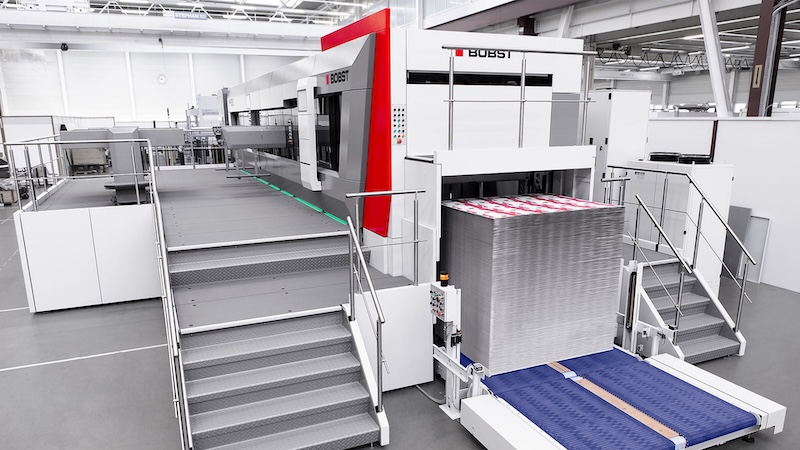
Bobst’s Mastercut 1.65 is a flatbed die cutter specifically designed for corrugated post print litho lam boards
There are too many die cutters available to go through them all so we’ve listed some of the most common to illustrate the sort of features that are needed. Bobst, for example, produces a number of flatbed die-cutters, offering different sizes and feature sets, all aimed at the folding carton market that also includes corrugated sheets. The range includes the Mastercut 1.65 PER, which has been specifically designed for the litho Lam post-print process, where litho or even digitally printed sheets are used as the top cover for the corrugated boards and laminated in place. It has the cutting strength to go through corrugated boards but is delicate enough not to damage the printed sheets. It will take boards up to 1.65 x 1.3m and up to 7mm thick, and runs at a speed of up to 7000 sheets per hour.T
hen there is the Chinese company Masterworks, which also makes most of Heidelberg’s postpress equipment. The range includes the EcoPress MK 1050E, which takes sheets up to 1050 x 750mm but with a maximum die cutting size of 1040 x 740. It will work with paper and cardboard as well as corrugated boards up to 4mm. It can run at up to 7500 sph.
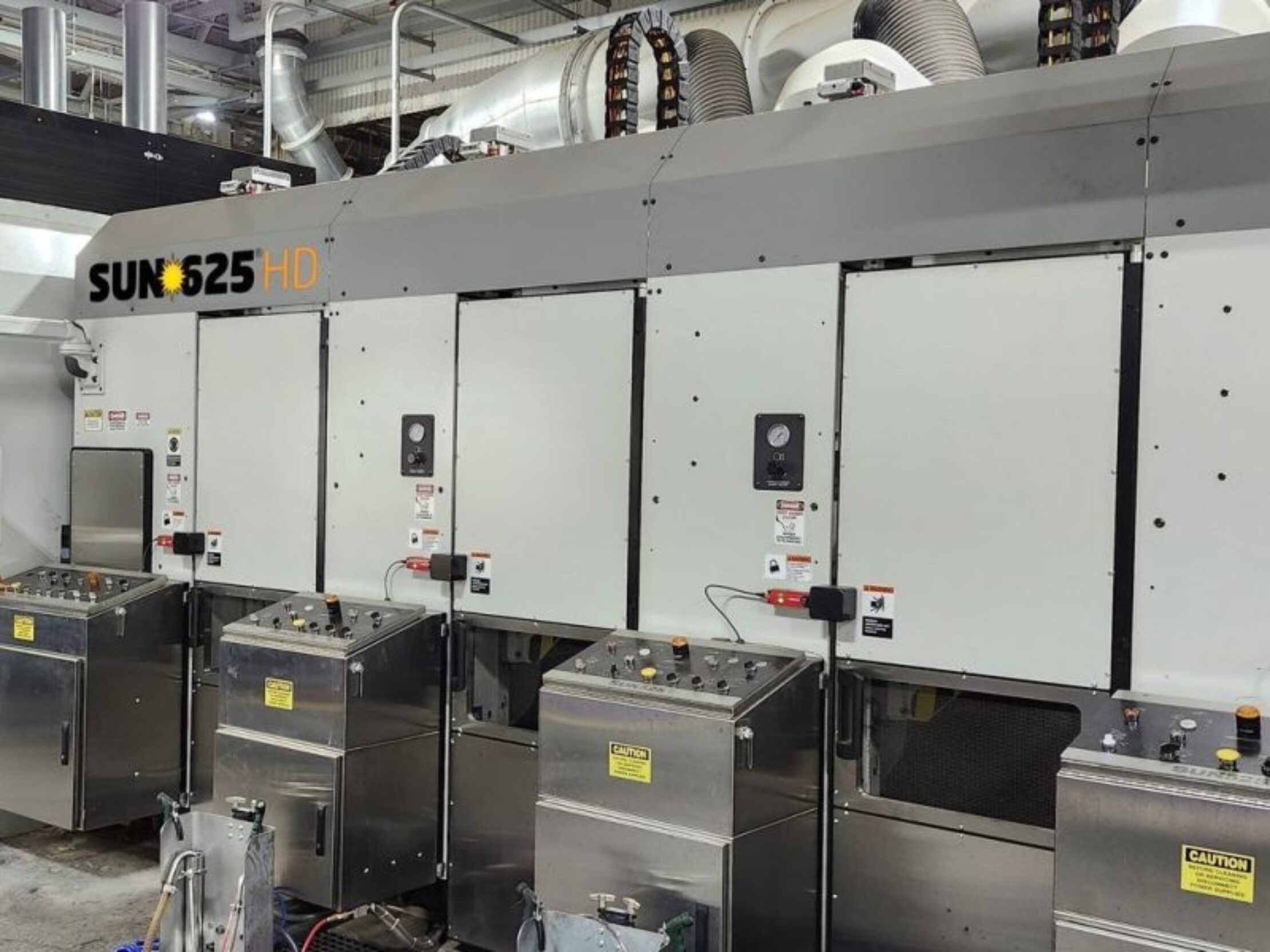
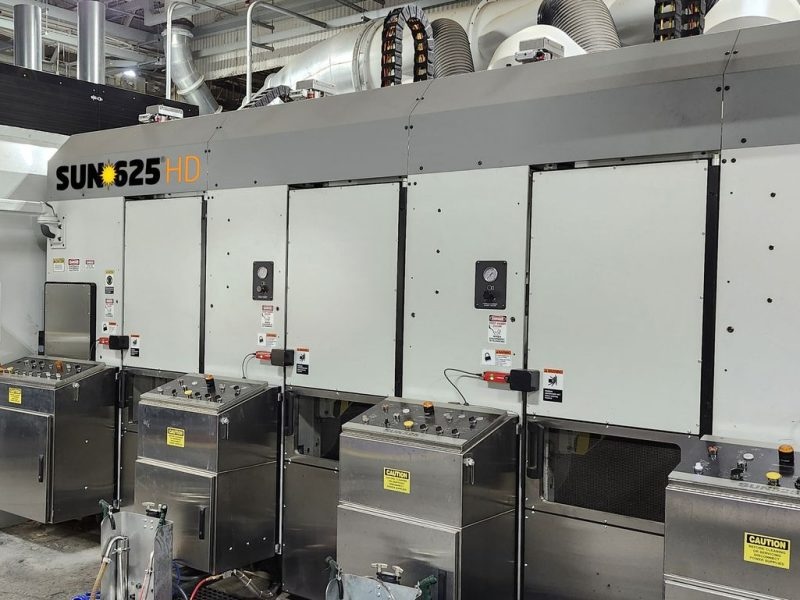
This Sun 625 HD is a rotary die cutter for the corrugated packaging market.
Koenig and Bauer sells a number of different die cutters, including both flatbed and rotary devices. Most of the flatbed die cutters will handle corrugated boards up to 3mm thick but the Ipress 145 Pro will take corrugated boards up 1.05 x 1.45m and up to 4mm thick. It runs at up to 7000 sph. Koenig and Bauer’s Celmacch subsidiary makes the ChromaCut series of rotary die cutters, which are usually installed with an integrated print unit. The fastest of these, the ChromaCut X Pro, takes boards up to 9mm thick and can produce up to 12,000 sph.
Sun Automation makes the Sun625 corrugated rotary die cutter, which is mainly designed for high volume packaging manufacturers. It will take sheets up to 1.53 x 3.17 m, with a top speed of 12,000 sph. It includes performance analytics and predictive maintenance as well as a flexo print unit. There’s also a HD version that offers a more robust construction, improved automation and more precise die cutting with faster speeds for longer runs.
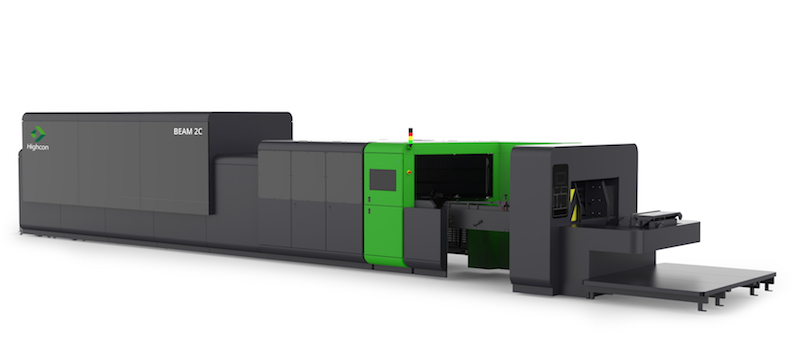
Highcon’s Beam 2C, seen here in the nonstop configuration.
There is a digital die-cutting option through Highcon, which makes a range of different machines designed to handle either folding carton or corrugated boards up to B1 size. This includes the Euclid 5C that’s aimed at smaller companies and the Beam 2C that is suitable for larger users with longer run lengths and multiple shifts.
Highcon separates the creasing from the actual cutting stage. For the creasing, Highcon uses a separate machine called a Beam Writer to create a special foil, via its Digital Adhesive Rule Technology or DART, which involves dropping a polymer fluid onto the foil to match the design in a DXF or PDF file and then curing this to form hard raised lines. This foil is then placed on the substrate and a pressure roller is used to force the raised lines to create creases on the substate. After this, the substrate moves on to the cutting, which is carried out by an array of CO2 lasers that can vary the cutting pattern for each individual sheet. Users can adjust the laser cutting depth for full cutting, half cutting, perforation, or etching and adapt the crease height to suit the substrate thickness as well as the stripping to suit the layout.
In addition, Highcon is developing a much larger machine, currently codenamed the Vulcan, which will handle 1.4 x 1.7m corrugated boards up to 5mm thick. The Vulcan is still some years off but Highcon is targeting a maximum throughput of 3000 full-size sheets per hour, which is around 7000 sqm/hr. As such, this is designed to do more than just handle short run packaging jobs and will compete directly against conventional die cutters.
In summary, die cutters are a major investment item but they are capable of converting high volumes of corrugated boards. Some manufacturers are now starting to add artificial intelligence software to enable predictive maintenance to cut down on waste and improve throughput as part of the continuing battle to control costs throughout production runs.
Register for Corrugated 2026, visitors can purchase super early bird tickets for €30 until 23 March by using the code FESG601.
Discover Corrugated 2026
Coming to Fira Barcelona, 19-22 May 2026, Corrugated is a new dedicated exhibition with curated conference content aimed at corrugated converters. The four-dy exhibition will be a lively display aimed at manufacturers of decorative and graphical corrugated packaging - where they can explore a varied showcase of the latest product solutions from leading brands covering machinery suppliers, services, software, consumables, printing equipment, converting solutions and plant logistics. Visitors can purchase super early bird tickets for €30 until 23 March by using the code FESG601.