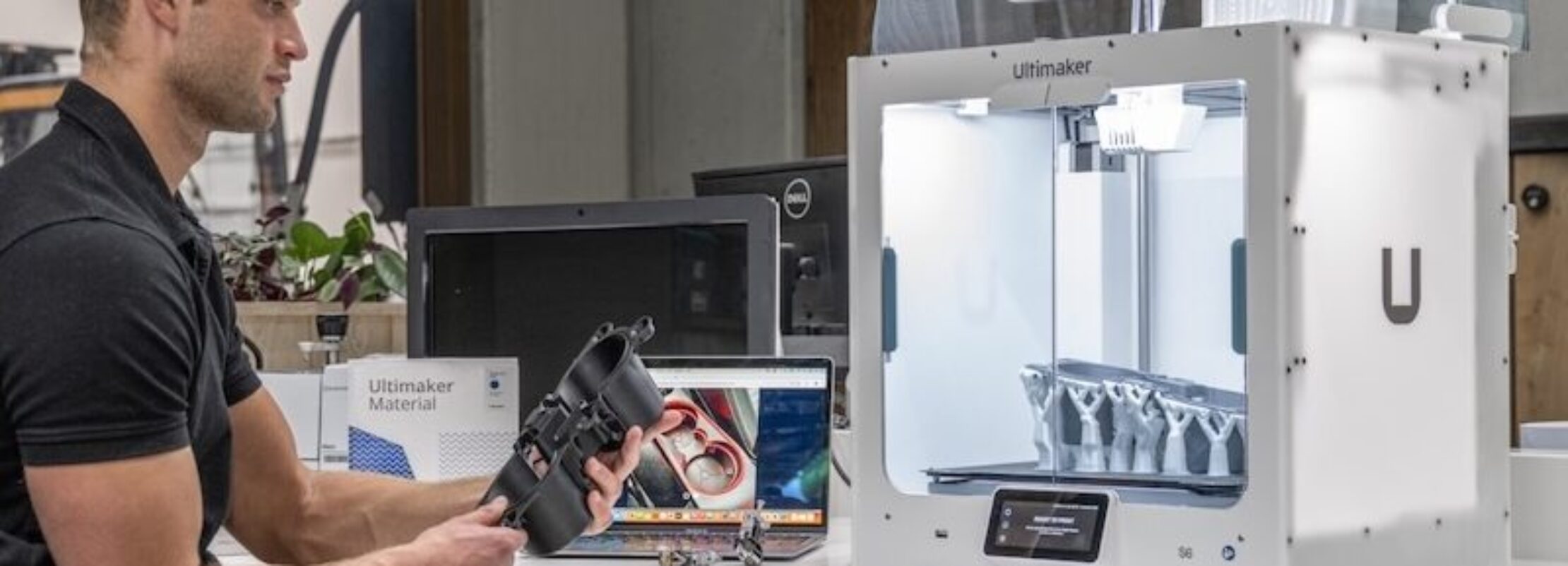
Wide format print service providers can leverage 3D printing (additive manufacturing) for both production efficiency and new revenue streams. Internally, 3D printers can create custom jigs, brackets, and light box frames. Externally, they can produce dimensional signage, channel lettering, or offer a custom parts bureau, adding a valuable new service to their business.
It’s tempting to think of 3D printing as just another branch of printing. After all, much of the language is similar, the same equipment vendors also sell 3D printers and some of the technology, notably inkjet, is common to both 3D and print. But once we get beyond the surface, its obvious that 3D printing, which is more commonly known now as additive manufacturing, is quite different from print. And yet there are still several ways that wide format service providers can take advantage of additive manufacturing.
One example would be for decorating other products such as drinks bottles or candle holders. The best way to ensure that such items will stay in place on a flatbed printer is to make a jig to hold them in place. Obviously you will need different jigs to handle the various sizes and shapes of these different items, and it takes time to make such jigs. But 3D printing offers a hassle-free method of building jigs to exactly the right dimensions to hold those objects firmly in place. Indeed, some vendors and dealers have sold 3D printers into the wide format market specifically for this purpose.
Another option is to make bespoke brackets for holding a display in place. Designing your own brackets allows you to add specific features such as a cable guide. However, you will have to thoroughly test any brackets you print yourself before relying on them to support any weight to avoid liability for any failure.
Another possibility is to 3D print frames for light boxes and other graphics. This can really come into its own if you are making curved or complex shapes, perhaps to match the shape of a customer’s logo or of the product being advertised. These sort of shaped frames can really enhance the graphic but they take time to make. Most 3D printers are not particularly quick but they can easily be left to print such objects unattended overnight.
You can also print bespoke objects to add an extra dimension to an otherwise flat display, such as a half sphere on top of a picture of a ball. Such features can help a graphic stand out and grab attention. Equally, you could 3D print braille letters to add accessibility to a wayfinding sign.
It’s also possible to create channel lettering on a 3D printer. The only limitation would be the build area for any given printer, though it’s possible to create parts of letters and bond them together to build up a complete sign. Using a 3D printer allows you to design all the brackets and fittings, such as cable guides, screw holes and LED lamp holders, directly into the sides of the lettering. That should make for a neater, simpler design as well as improving the overall robustness. And of course if the sign does become damaged, then it’s relatively easy to just reprint the damaged section from the original CAD file, ensuring that customers will come back to have their graphics maintained.
Yet another option is to create dimensional signage, such as a large model of a parrot to advertise a shop selling pet food, or an A-board in the shape of a smartphone outside a mobile phone shop. This kind of marketing usually involves one-off models that are hard to make cost effectively using more conventional methods but become just another print job with a 3D printer.
It obviously follows that a wide format print service provider can also offer a service producing custom objects and parts to customer designs. That could include prototypes for new designs as well as short run parts. However, there is considerable variation between different 3D printers and the scope of this type of service depends upon the capability of the 3D printer in use.
The main limitation is the type of materials that the additive manufacturing machine can run. The material range will depend on the technology you invest in. There are several different types of 3D printer, but one of the easiest and most widespread technologies to start with is FFF Fused Filament Fabrication, which is sometimes referred to as FDM Fused Deposition Modelling. This works by extruding a plastic filament through a heated nozzle to build up an object one layer at a time. This basic approach is used in relatively cheap models, but also in larger industrial additive manufacturing machines so there is a good range of different filaments or build materials available.
The FFM/ FDM materials mostly revolve around different types of plastic, including rigid materials like PLA, ABS and PETG as well as flexible materials like TPU. There are also a number of composite materials, usually including a mix of nylon or carbon fibre for added strength. Many of these will be certified for particular characteristics, such as tensile strength, or resistance to heat or various chemicals. Some 3D printers can also handle metals and even ceramics, but these tend to be the more expensive industrial machines designed for production.
So it’s important to think about the various applications that you might want to work with, and therefore what materials you might need in order to determine what type of 3D printing technology you should invest in.
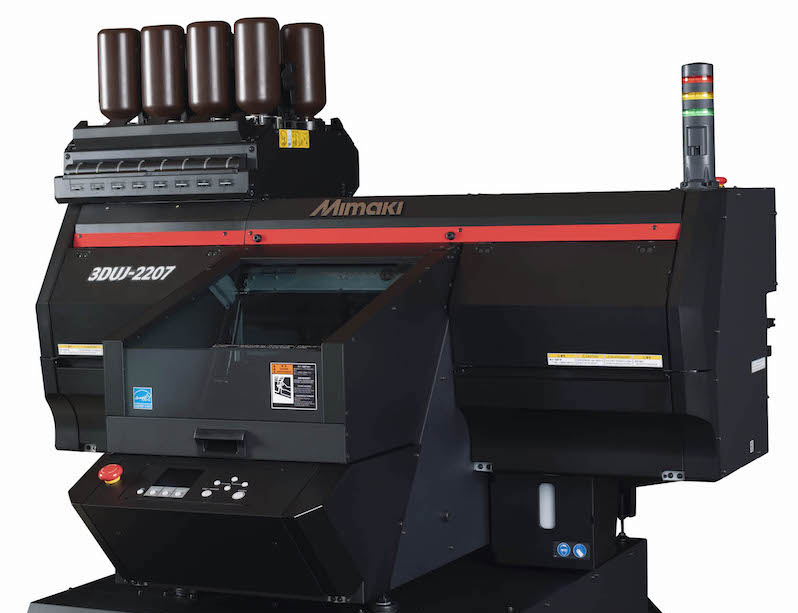
Mimaki’s 3DUJ-2207 3D printer is based on the chassis from a UJF-3042 industrial flatbed printer
Another major consideration that’s not often written about is the mentality required to make a success out of additive manufacturing. Most people find it difficult to think in terms of three dimensional objects but anyone who’s regularly producing packaging or point of sale/ point of purchase displays will already be used to that, and to using CAD software. It’s also worth noting that many printing press vendors, including Mimaki, Ricoh and HP, also make 3D printers.
In conclusion, there are many ways that wide format service providers can make use of 3D printing. That could be to help with production processes, such as making jigs or brackets; or it could be to enhance display graphics or even to make large models for marketing customers; or to establish a separate bureaux business, making parts on demand for customers. Additive manufacturing offers another string that wide format service providers can add to their bow.
FESPA World
With over 30 years experience, FESPA World offers the latest features, industry news, blogs, press releases and podcasts relevant to the print community. The content covers a wide range of sectors including screen printing, digital printing, textile printing and more and is sent once a month.